
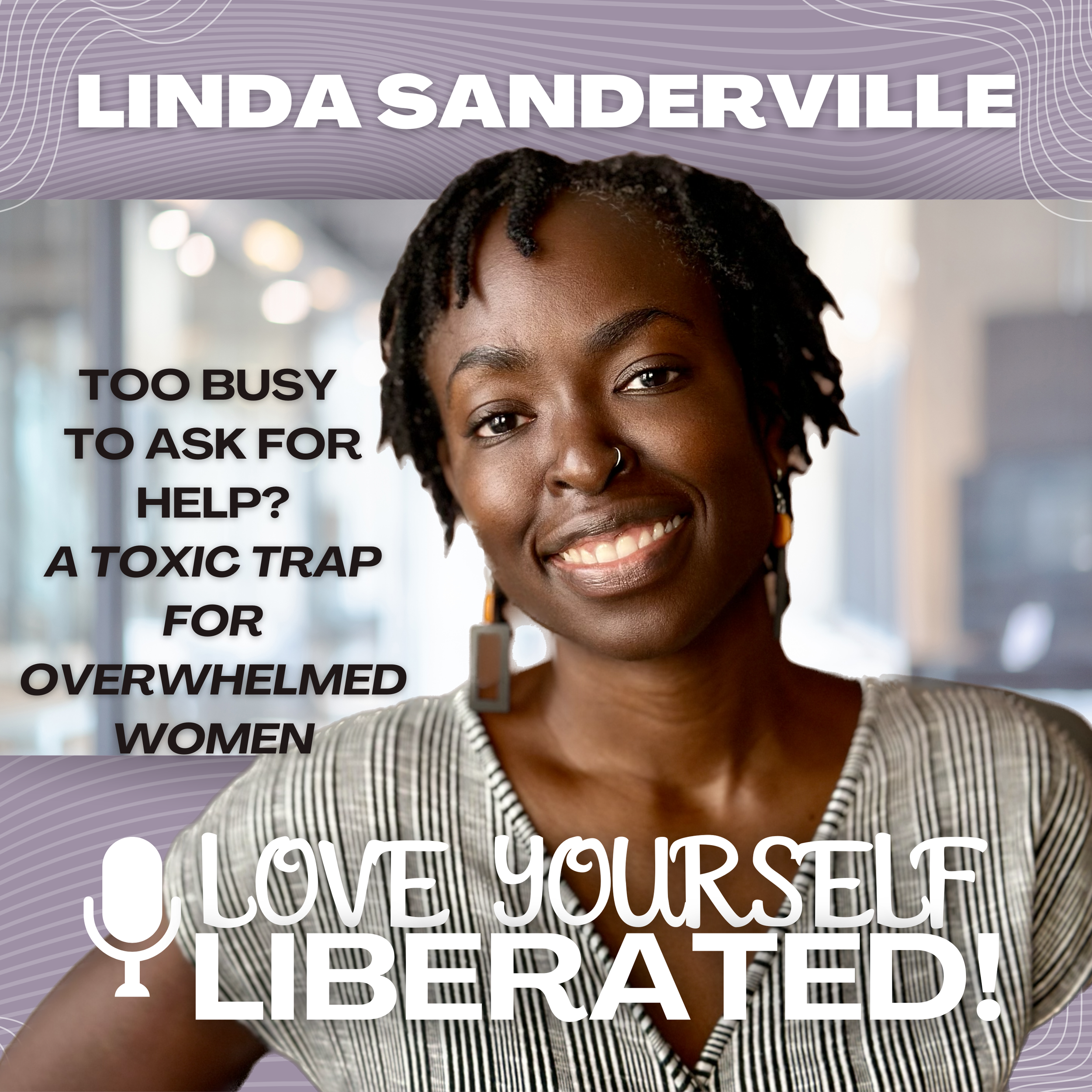
S1:E15 Too Overwhelmed To Ask For Help!
SHOW NOTES
If you've ever been told to slow down, ask for help, stop doing it all yourself, and found yourself nodding along while quietly thinking you're too busy to even figure out how to ask, this one is for you. It's not all in your head. There are real, valid reasons reaching out feels so hard, from the societal expectation that women are just built to handle it all, to perfectionism and self-reliance, to the fear of being a burden or being judged for struggling, to the simple fact that setting up help takes time you don't feel like you have. In this episode I walk through each of those barriers, including the cultural ones that make asking for support feel like a personal failure, so you can stop blaming yourself for finding it difficult and start giving yourself some grace. Part two, coming soon, gets into how to actually create the support you deserve.
Warmly,
Linda
💖 For comprehensive support from a licensed therapist, reach out to me through:

Meet Your Host!
Linda Sanderville, LCSW, RYT-200 is the founder of Satya Counseling & Yoga LLC. She specializes in concierge therapy for female founders and public figures, helping high-profile women navigate public scandal, executive burnout, and the values that will define the second half of life. Based in Albuquerque and serving clients virtually in DC, Maryland, Virginia, and beyond, Linda combines clinical expertise with somatic wisdom to help leaders reclaim their truth.
Read below for full transcript.
[00:00] Intro & Why Asking for Help Feels Impossible
Hi, I'm Linda, an emotion coach and hypnotherapist who also loves a good sunrise yoga class, listening to the belly laughs of my baby boys, and hunting down the best vegan donuts. This podcast is for ambitious and high-performing women who want to feel fulfilled in all areas of their life. I'm here to give you practical tips and mindset shifts that will help you put your self-love skills into action. Welcome.
If you are a busy woman like me, then you may have been told from time to time that you should slow down, that you're taking on too much and have a lot on your plate. And you may even have those who really seem to love and care about you telling you that they would like you to ask for more help, that they'd like you to reach out for more support, and that you don't have to do it all yourself, right? All these things that we as busy women can hear quite a lot.
Well, I want to just highlight today some of the reasons why you may have very valid concerns about actually following through with asking for help, maybe even feeling like you are too busy to ask for help, right? So it's not all in your head. There are a lot of reasons why we feel the way that we do, and why we can be really overwhelmed. And while it may seem like it makes sense that we would want to ask people to support us, to stand in for us, or to delegate tasks, it's not always so easy. It's not as easy as that.
[01:33] Societal Expectations, Perfectionism & the Superwoman Myth
Linda: So one of the first factors that's huge, it's kind of the air we're all breathing, the water we're all swimming in, is the fact that there are certain societal expectations for us as women. Whether you are a working single woman, a woman who has a family and a job, or are staying at home with your kids, there's a lot of expectation around the fact that we would be able to juggle all these things by ourselves, or that we are just built to be able to handle all of those responsibilities and tasks, and to be able to juggle those relationships. Women are assumed to be very relational, and they can do it all, they can maintain it all. And so those expectations can make it hard for us to say, actually, I can't, because we drink the water too. So we think that, yeah, I'm fine. Of course, I can handle this. We're good.
And of course, along with that expectation from general society, both around our gender and whatever else we have going on, there's that pressure to then not seem weak, or not seem like a failed woman, because we can't seem to get it all together. And then, along with that, very much attached to it, is this tendency towards perfectionism that a lot of us have. This tendency towards perfectionism and self-reliance. And I do find that that is much more heavily ascribed to women than men.
That's not to say men can't struggle with that too. And certainly self-reliance, here in America, is a really strong value, the idea that you can do it on your own, pull yourself up by your own bootstraps. And that really does trickle down to us as women too, in our individual roles in our lives, that we are expected to be able to do everything well. Black women can have this in particular with that sort of superwoman myth, that we can just kind of be really sexy, we can be really strong, we can shoulder all the burdens. And so there's a way in which that even gets further warped for Black women. So it's hard when you feel like you may not meet your own standards, let alone other people's standards.
[03:58] The Fear of Being a Burden
Linda: And then of course, for women, we often don't want to burden others. I know that I can really be caught up in this, and I've learned to catch myself and find myself thinking those thoughts, because I'm like, that's not true. But we can really be afraid that we're going to burden someone else if we ask for help. If we're constantly asking for help with the kids, I have two young boys and I can feel like, oh, I don't want to inconvenience. And it's like, well, our family is happy to spend time with our boys.
But we can get these messages in our head like, oh, it's going to be a burden if I ask them to pick this up for me from the store if they can, or it's going to be a burden if I ask them to bring over half the meal if they're coming over for dinner, like I should just be able to make it all. And so we can really feel forced to not be an inconvenience in our relationships.
And there's a lot of myth and lies that are going on with those beliefs. Because the truth is that when we care for people, we want to help them, the same way that we want to help other people when they're going through something or they need some extra help, people want to be able to do that for us. And so we're really kind of robbing them of the opportunity to show up for us when we give in to those lies and those false ideas that we're going to be an inconvenience somehow if we reach out for help with these tasks or responsibilities.
[05:30] Fear of Judgment & the Time It Takes to Set Up Help
Linda: And then of course, you have the ever-present fear of being judged around any kind of mental health, or even physical health, limitations, that again, we'd be seen as weak, as failed women, if we are having struggles with managing it all in our lives because of particular health struggles. And of course, even in our very woke day and age, mental health struggles are still not really seen with the same seriousness as physical health struggles, even though there's way more overlap than there is difference. But right, we can have that fear that we're going to be judged, misperceived, looked down on if it's actually due to a struggle of that kind that's making it hard for us to carry out those tasks. Because again, that's failing society's expectation of us.
And this one's going to sound kind of funny, but if you're like me, you're going to be able to relate. Sometimes we just have too many time constraints, and we're just too busy to figure out how to delegate. Because even delegating, even figuring out how to automate help or things like that, all that stuff still requires you to sit down at some point and plan it out. It still requires you to sit down at some point and pause and actually set up those systems. It's not like you just think, oh, okay, I'm going to delegate that, and then it's done. No, you have to figure out, okay, who do I trust? Who has capacity? Who has willingness?
When we ask a couple people and see what the response is, okay, let me experiment and see how that went, and then recalibrate if I need to. So it still does actually take some time to set up the help in the first place. And so if you're feeling really busy and overwhelmed, well, it's going to be a challenge. So that also can be a factor that plays into why you feel like, I'm too overwhelmed to even start thinking about how to be less overwhelmed.
[07:35] Cultural Barriers & Giving Yourself Grace
Linda: And then of course, in some cultures, it's actually looked down on in general to reach out for support or to say, oh, I can't manage this, can you help me? It doesn't mean that you won't get the help, but sometimes, I know for West African cultures, Caribbean, sometimes Latina, there's an expectation that you should just be able to handle it. Certain, most Asian cultures, if you're struggling because of mental health or difficulties like that, you're likely to be seen as weak, like there's something just personally wrong with you. And so that can also be a barrier for us wanting to reach out in that way, because nobody wants to be seen like that. We all want to be included. We all want to feel like we belong. So that can really be a hindrance when it comes to getting support or delegating.
And so the thing is, I hope I'm talking about this because it's so important that we actually do, it's important that we challenge our own misperceptions, and that we get over some of the fears that are very valid. Sometimes we're like, I don't want someone to take over or help me with that task, because I might take it over, or they may say that they're okay with it, but they might be suddenly judging me and that comes out later, or I hear them talking about me to somebody else, you know, on the other side of it. And these are valid things that can happen. And there are ways to control for that.
There are ways to experiment with the process, and then get more clear about who your people really are, that can show up for you in this way. And even making space for that with your mindset, like shifting in your mindset that actually it's a strength that you're just admitting what no one else is willing to admit, that these expectations are impossible to achieve.
So I want you to consider some of those aspects of why it's so difficult, just to give yourself some more grace, give yourself some more patience and understanding. It's not that there's something wrong with you, or that you're just being difficult, or you're just being ineffective, or whatever it is. There are a lot of pressures that we face that make it a challenge to do that. And that's why so many people feel isolated and overwhelmed. But you don't have to be that anymore. So there are ways to manage to come out of that, come out of that cycle, and to create a different experience for yourself.
And I will come back with a part two that focuses more on some of the ways that you can begin to create that for yourself. And of course, as always, you can check out my course. It goes into all of these things for busy, overwhelmed women, because that's who I love to help. I don't think you have to live like that. So be sure to check out the links below. And I will see you next time.
You hung with me to the end, my shero. If you benefited from this episode, please say thanks by leaving a wonderful review. It helps me know what's helping you the most and allows more like-minded women to find and learn from this podcast. We don't want to keep all the good stuff for ourselves. See you next time.
[Editing Note: The Love Yourself Liberated! group program is not currently available. If you are interested in this content and guidance, it is now exclusively provided through my concierge psychotherapy practice, Satya Counseling & Yoga.]
Interested in Working with an Internal Family Systems Therapist who supports Public Figures in McLean, VA, Columbia, MD or Santa Fe, NM?
Is the inability to rest or slow down leading to burnout in your professional and personal life? Reclaim your joy and vitality while managing your professional commitments through holistic and evidence based counseling. Our specialized support at Satya Counseling & Yoga is designed to fit seamlessly into your busy life, empowering you to conquer trauma-based responses and thrive. Prioritize your mental well-being – embark on a transformative journey towards a happier and more fulfilling life by following these three steps to get started:
Schedule a complimentary 15-minute call to see if we’ll be the right fit.
Begin meeting with me, therapist and trauma-informed yoga teacher, Linda Sanderville, to rediscover your healthy, authentic self.
Start moving forward in your personal and professional life in a positive and healthy way!